Living With a Roof That Moves
A roof with a motor and a control asks something different of a household than a fixed one ever did.
September 21, 2026 · 3 min read
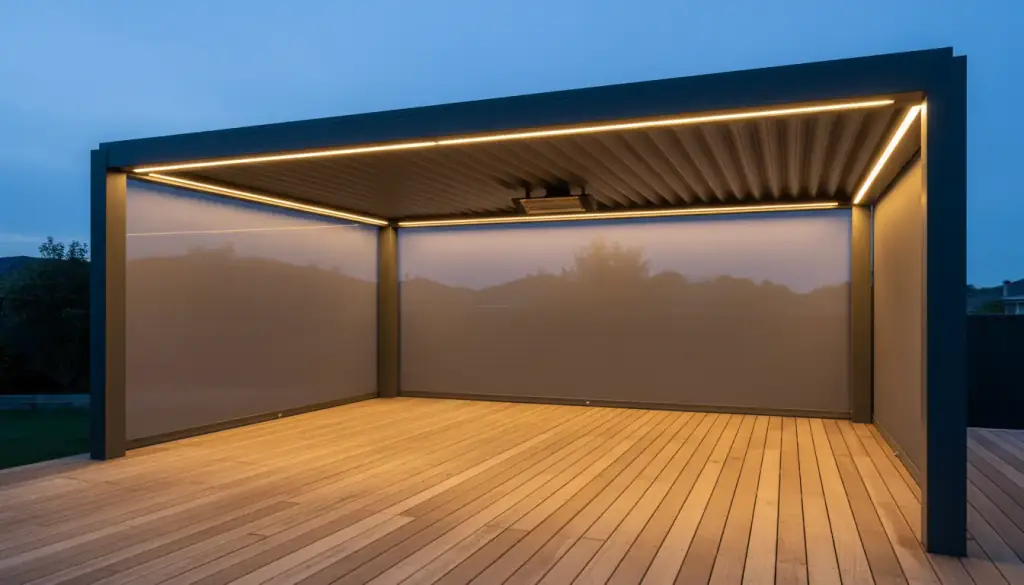
A fixed pergola asks nothing of the people who own it, beyond the occasional coat of stain. A louvered roof is a different kind of object entirely: something with moving parts, a motor, and a control that has to be understood rather than just looked at. That's a fair trade for a lot of households, but it's worth knowing what living with it actually looks like day to day, not just what a brochure photo shows.
What the button actually does
Across a single afternoon, the blades might go from fully open at lunch, to angled for filtered shade once the sun swings around mid-afternoon, to closed flat if a storm rolls in before dinner. That's three different rooms out of one structure, and the only thing that changes between them is a control, not a second project and not a second bill. Most households settle into a pattern fairly quickly: open by default, angled when the light gets harsh, closed only when the sky actually calls for it.
When rain shows up mid-afternoon
Northern Michigan weather turns fast enough that a clear sky at noon and a downpour by two isn't unusual. The advantage of a louvered roof over a fixed one shows up exactly in that moment: a table set for lunch stays dry without anyone grabbing plates and running for the door. The blades close, the water sheds toward wherever the drainage was planned to send it, and the meal continues under a roof instead of moving indoors halfway through.
What closing the roof for a Michigan winter means
Northern Michigan winters aren't a season most people are sitting outside in regardless of the roof overhead, and the louvered system is built to be closed and left through the cold months rather than actively used the way it is from May through October. Closing it down for winter is a matter of putting the roof into that state and leaving it there, not a project that gets redone every single spring.
What it sounds and feels like day to day
The blades move with a low, mechanical hum rather than silence, the same category of sound as a garage door or a retractable awning rather than anything jarring. It's noticeable the first week and then it isn't, the way most household mechanisms fade into the background once the novelty wears off. What doesn't fade is the habit of checking the sky before deciding how to leave the roof set for the afternoon, which is a small shift in how people think about their own backyard: the weather becomes something to respond to in real time, rather than something that simply happens to a fixed structure regardless of what anyone does.
The small attention a mechanism wants
- Keeping the blade tracks and drive clear of leaves and debris that collect over a season
- Paying attention if the motion starts to sound or move differently than usual, the same way anyone would notice a garage door acting off
- Giving the structure the same seasonal look-over as anything else outside, rather than assuming a motorized system needs no attention because it's the fancy one
None of that is a large commitment, but it's a genuinely different relationship than the one a fixed pergola asks for, and it's worth going in with that expectation rather than discovering it later, mid-season, with guests on the way over.
What changes across a full year, not just a day
A fixed pergola looks the same in April as it does in October. A louvered roof, screens and all, moves through a full range across a Northern Michigan year: wide open through the brightest part of summer, angled and screened through the buggy stretch of August evenings, closed and heated through the cooler edges of spring and fall, then shut down entirely for winter. The same footprint of deck does noticeably more work across those months than a fixed structure ever could, which is really the whole argument for taking on a mechanism in the first place. It isn't about the button being impressive. It's about how many more months of the year the space underneath it actually gets used.
Mammoth Outdoor Living talks through exactly this, what a day with the system actually looks like and what it asks of the household who owns it, before anything gets installed. That conversation usually starts with a call to (231) 631-3476, and it's a fair question to ask before committing to a structure with moving parts, rather than after.
Mammoth Outdoor Living, (231) 631-3476
Call (231) 631-3476More articles
The Ten-Month Problem With Every Deck in Northern Michigan
Northern Michigan gives a deck about ten good weeks a year by default, and every piece of an outdoor room exists to push past that.
Fixed Pergola, Solid Roof, or Louvered: What Each One Actually Gives You
There's no single right roof for a covered deck, only the one that matches how a specific yard actually gets used.