The walls
Motorized screens that take the wind, sun, and bugs out of the room
Screens that drop down the posts on a motor and take the wind, the low sun, and the bugs out of a Northern Michigan evening without walling off the view.
Chapter 01
The three things a screen actually takes out of the room
A louvered roof solves for rain and for direct sun overhead, but it does not solve for what comes in sideways. Motorized screens handle three separate problems, and they are not interchangeable: wind coming off the water on a Grand Traverse Bay evening, low sun in the early morning or late afternoon that no roof pitch can block, and the mosquitoes that end an August evening on schedule whether you are ready to go inside or not.
Most homeowners think of a screen as solving one of those, usually the bugs, and are surprised how much of the wind and glare problem it also takes care of. A single motorized screen, dropped on the windward side of a deck, changes how long people actually stay outside more than almost any other single addition to the structure.
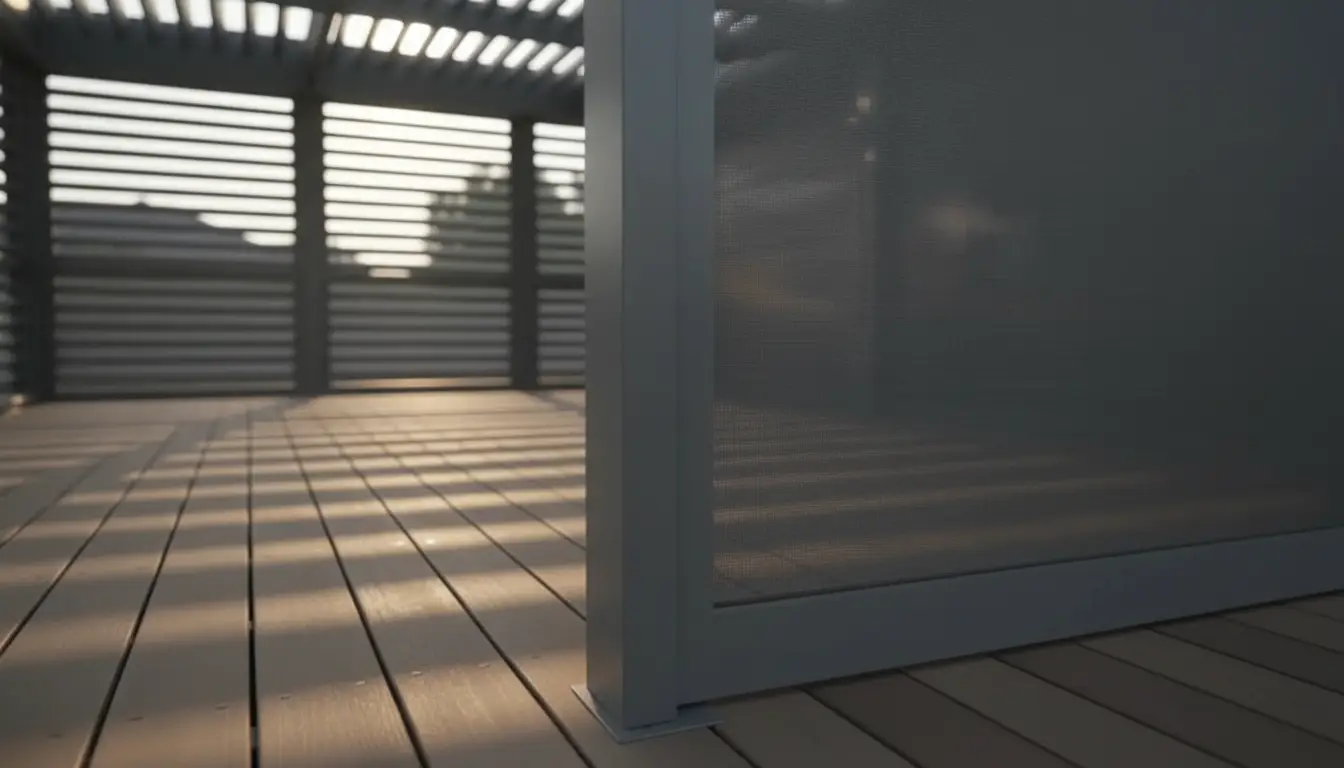
Close view down the vertical track of a motorized screen mounted on a cedar post, taut dark mesh filling one side of the frame with the lit deck reading through it
Why a screen is a structure decision, not an accessory
A screen track wants a post to land on, and the head box that houses the motor and the rolled mesh wants somewhere to disappear into, not hang off the outside of a beam. That only works if it is planned as part of the pergola frame from the start, with the post spacing and the header sized to take it.
Retrofit one onto a structure that was never laid out for it and you get the version everyone recognizes on sight: a box bolted to the face of a beam, wiring run externally along a post, a track that never quite lines up with where the post actually sits. Specify screens with the roof and none of that compromise is necessary.
Chapter 03
Where screens disappoint people
The complaints we hear almost always trace back to one of a small set of choices made at the start. A mesh picked for how much view it preserves gets asked to also block afternoon sun, and it cannot do both jobs equally well. A bottom bar dropped onto a deck that was never checked for level has nothing solid to seat against, so it never seals the way it should.
Span is the other one. A screen run built wider than the mesh wants to cover will bow under wind, even good mesh, because the physics do not care how it looks in a showroom. Getting the bay width right at the design stage is what keeps a screen sitting flat years in.
Using screens with the roof
The roof and the screens are meant to work together, not as a single setting. Blades closed with the screens down seals the space against a hard rain and cuts the wind at the same time, the setup for weather you would otherwise go inside for entirely. Blades open with the screens down is a different room again: full sky overhead, but the bugs and the breeze off the water kept out at the sides.
Which combination you want changes through a Northern Michigan evening, sometimes within the same hour, and that is the point of building both into one structure with one set of controls rather than treating a screen as an add-on. Reach the shop at (231) 631-3476 to talk through which side of the deck actually needs one.
Mammoth Outdoor Living — Registered Michigan company since 2021. Call (231) 631-3476.