Fixed Pergola, Solid Roof, or Louvered: What Each One Actually Gives You
There's no single right roof for a covered deck, only the one that matches how a specific yard actually gets used.
September 21, 2026 · 4 min read
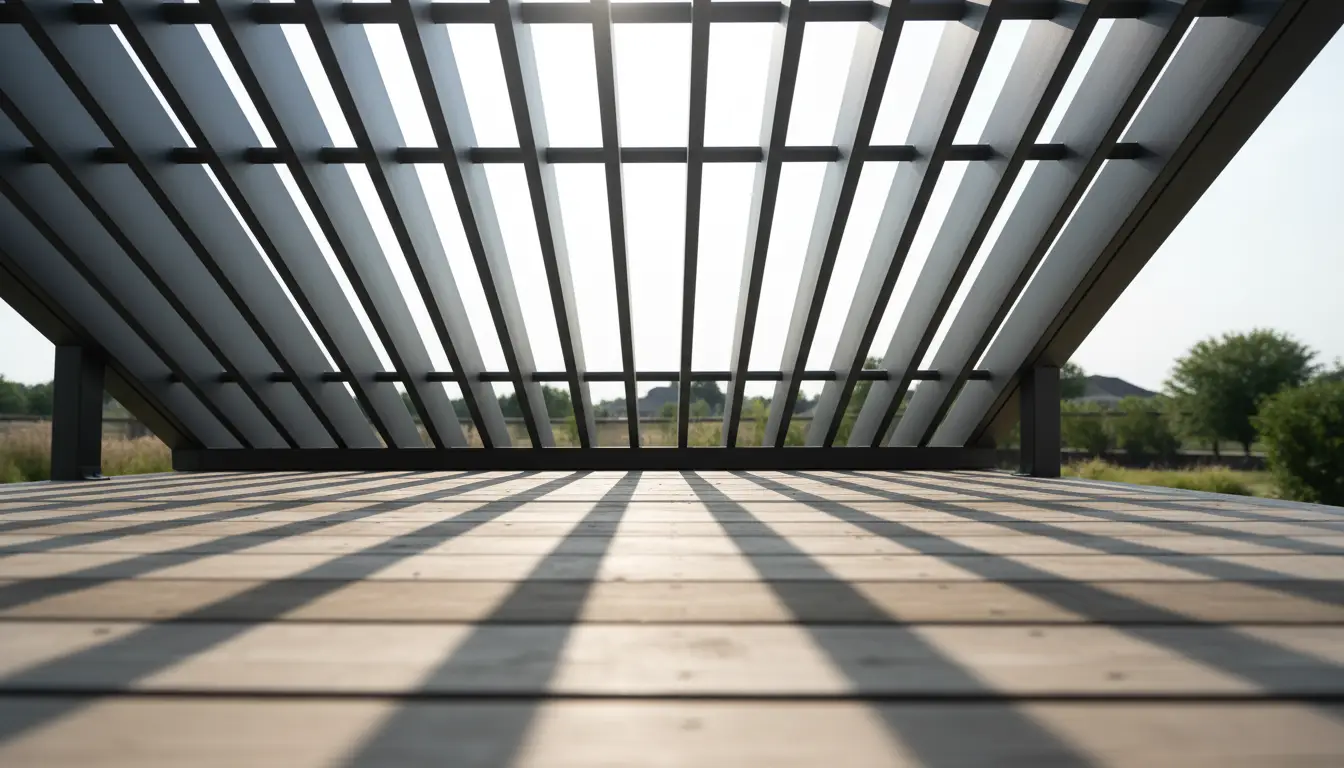
Ask five different outdoor living companies what to put over a deck and the answer will likely be shaped by whichever product that company happens to sell. Strip the pitch away and there are really only three structural options for covering a deck: a fixed slat pergola, a solid roof, and a louvered roof that opens and closes. Each one trades away something to get something else, and none of the three is wrong for every yard.
A fixed slat pergola gives you a shade pattern, once
A traditional pergola with fixed rafters or slats casts whatever shadow the angle of those slats and the angle of the sun happen to produce on the day it was built. In June at noon that might be exactly the dappled light most people picture when they hear the word pergola. By August at six in the evening, with the sun much lower in the sky, the same structure can let in nearly as much direct sun as an open patio. The shade pattern doesn't move with the day or the season, because nothing in it can move. It's also the simplest of the three structures, with nothing to wire, program, or service beyond the wood or aluminum itself.
A solid roof gives you weather protection you can't turn off
A solid roof over a deck, whether it's an extension of the house roofline or a freestanding structure, solves rain completely and solves shade completely. It also removes the option of full sun entirely, on the one October afternoon everyone actually wants it, or the crisp February day when a shoveled path is the reward for sitting in warm sun with a coat on. A solid roof is also the most permanent of the three choices, and the least reversible once it's up.
A louvered roof gives you the choice, and asks for something back
A StruXure motorized louvered system is built so the blades pivot: fully open for direct sun, angled for filtered shade, or closed flat for a sealed, weather-tight roof, changed at the touch of a button rather than by rebuilding for the season. The tradeoff for that flexibility is a mechanism. There's a drive system and controls that a plain wood pergola never has, and that means there's something to think about that the other two options simply don't ask for.
Who each one actually suits
- A yard used mostly for a few weeks of peak summer, where the look matters more than the flexibility, often suits a fixed slat pergola.
- A space meant to function as an outdoor room every day regardless of weather, where shade and rain protection are the only two states that matter, can suit a solid roof.
- A deck that gets used across a longer stretch of the year, where the weather and the sun angle both change week to week, is where a louvered roof earns the extra complexity.
The look changes more than the function does
A fixed pergola reads as a garden structure, something with a slight lean toward the traditional even in a modern yard, because the eye recognizes the pattern of evenly spaced rafters instantly. A solid roof reads as an extension of the house, especially when the roofline and siding match, and it tends to make the space feel like a true room rather than a yard feature. A louvered roof sits somewhere between the two: clean horizontal lines when the blades are closed, an open frame when they're not, so the same structure can look different depending entirely on the hour and the weather. None of these three looks is more correct than the others. They just suit different houses and different tastes, and it's worth looking at photos of all three against a specific house before deciding which one actually belongs there.
What doesn't change no matter which you pick
Orientation still matters. Drainage still has to go somewhere specific. The size of the usable seating area underneath still has to be worked out before the structure goes up, not after. None of the three choices skips that groundwork, and getting it wrong under a fixed pergola is just as much of a problem as getting it wrong under a louvered one. It's only harder to fix afterward, because there's nothing left to adjust.
There's also the question of what happens later, once the structure is up and a household's habits become clear. A fixed pergola that turns out to face the wrong direction for evening sun is a hard structure to argue with; the fix is usually a curtain or a second, separate shade piece bolted on afterward. A louvered roof absorbs that same mistake far better, because the angle of the blades is a daily decision rather than a permanent one baked into the framing. That flexibility is exactly what the extra mechanism buys, and it's worth weighing against the simplicity the other two options offer instead.
Mammoth Outdoor Living installs the StruXure motorized louvered system specifically, along with the lighting, screens, fans and heat that go with it, and that's a deliberate choice rather than the only option that exists. If a fixed pergola or a solid roof is genuinely the better fit for a particular yard, that's worth knowing before a quote gets written, not after. (231) 631-3476 is a reasonable place to start that conversation.
Mammoth Outdoor Living, (231) 631-3476
Call (231) 631-3476More articles
The Ten-Month Problem With Every Deck in Northern Michigan
Northern Michigan gives a deck about ten good weeks a year by default, and every piece of an outdoor room exists to push past that.
What to Work Out Before Anyone Quotes a Covered Deck
A more accurate quote starts with a homeowner answering a handful of questions no contractor can answer standing alone.