How Outdoor Heat Actually Works Above a Deck With No Walls
An outdoor heater was never meant to warm the outdoors, and understanding what it does instead changes where you'd put one.
September 21, 2026 · 3 min read
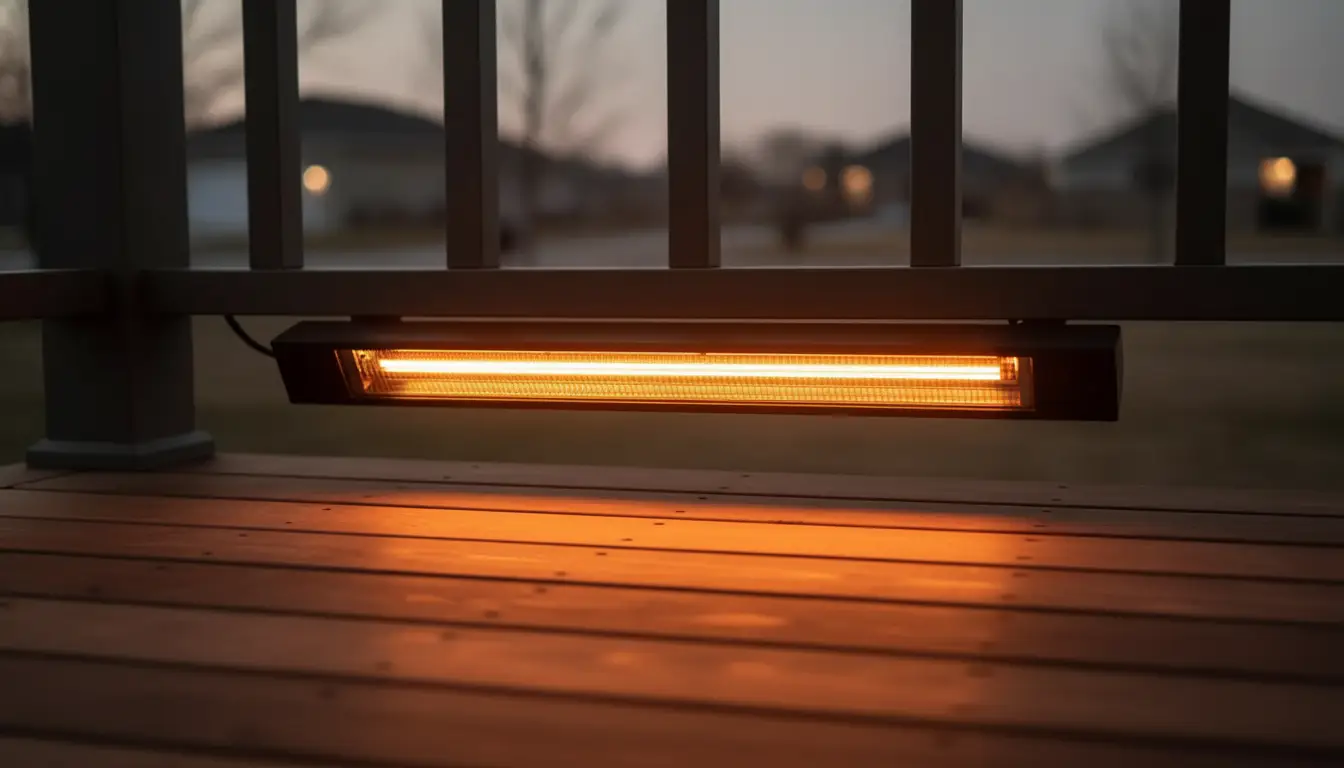
The phrase outdoor heating suggests something like an outdoor furnace, warming a whole patch of yard the way a furnace warms a house. That isn't how any outdoor heater actually works, and understanding the difference is the difference between a heater that gets used well into October and one that gets switched on twice and quietly forgotten.
You can't heat the outdoors, and radiant heat doesn't try to
An outdoor space with no walls has no air to trap. Any heat added to the open air around a deck disperses into the rest of the yard within a few feet, which is why an indoor-style space heater does almost nothing outside. Radiant heaters work on a different principle entirely: they warm the people and surfaces directly in their line of sight, the way sunlight warms skin on a cold day even before the air temperature has changed at all. Switch a radiant heater off and the warmth stops the moment someone steps out of its path, because it was never heating the air to begin with.
What a closed roof changes about the math
Under an open sky, whatever a radiant heater puts out drifts upward and away, and a lot of its usefulness depends on how still the evening happens to be. Under a closed louvered roof, there's a ceiling for that warmth to reflect and hold against, and the space starts to behave more like a room, even without walls around it. This is the specific reason heat and a louvered roof so often get specified together: neither one does its best work alone, and the roof is doing real thermal work even when nobody notices it's the roof doing it.
Aim and mounting height decide whether anyone actually feels it
A heater mounted flush under a beam and aimed at the seating does its job. The same heater aimed at the walkway between the door and the table, or mounted too high to reach anyone sitting down, does almost nothing for the people it was installed for. Mounting height and aim get planned alongside the rest of the structure's wiring, at the framing stage, for the same reason lighting does: it's far easier to get right before the beams are closed up than to retrofit afterward.
The mistakes that waste a heater
- Aiming at a walkway or an open patch of deck instead of where the table and chairs actually sit
- Specifying heat for a space with no roof over it at all, so most of the output leaves straight upward
- Relying on a portable unit that gets dragged out for one evening and left in the garage for the rest of the season, until the household stops bothering with it
The one combination that cancels itself out
A ceiling fan and a radiant heater running at the same time, on the same evening, work against each other. The fan moves air across the skin specifically to cool it, which is exactly the sensation the heater is trying to counteract. Both are useful pieces of the same system, just not at the same hour. Late spring and early fall call for the heater. A still August afternoon calls for the fan. Running both together on the same evening is wasted effort in both directions, and it's worth saying plainly rather than selling both without the caveat.
Heat works best as part of a closed system, not a standalone fix
A single heater bolted onto an open deck, with no roof and no screening around it, is fighting an uphill battle no matter how well it's aimed. Wind carries the warmth sideways before it reaches anyone, and there's nothing overhead to hold any of it in place. Pair the same heater with a closed louvered roof and a motorized screen dropped against the wind, and the equation changes completely: the heat has somewhere to sit, the wind that would otherwise scatter it is blocked, and the difference between a space that works in April and one that only works in July comes down to exactly this combination working together rather than any single piece carrying the whole job.
This is the piece of a covered deck that most directly decides whether it's a June-through-August space or an April-through-October one. Mammoth Outdoor Living specifies heat as part of the structure itself, not as an accessory bolted on afterward, and (231) 631-3476 is a reasonable way to find out what that actually looks like for a specific deck.
Mammoth Outdoor Living, (231) 631-3476
Call (231) 631-3476More articles
The Ten-Month Problem With Every Deck in Northern Michigan
Northern Michigan gives a deck about ten good weeks a year by default, and every piece of an outdoor room exists to push past that.
Fixed Pergola, Solid Roof, or Louvered: What Each One Actually Gives You
There's no single right roof for a covered deck, only the one that matches how a specific yard actually gets used.